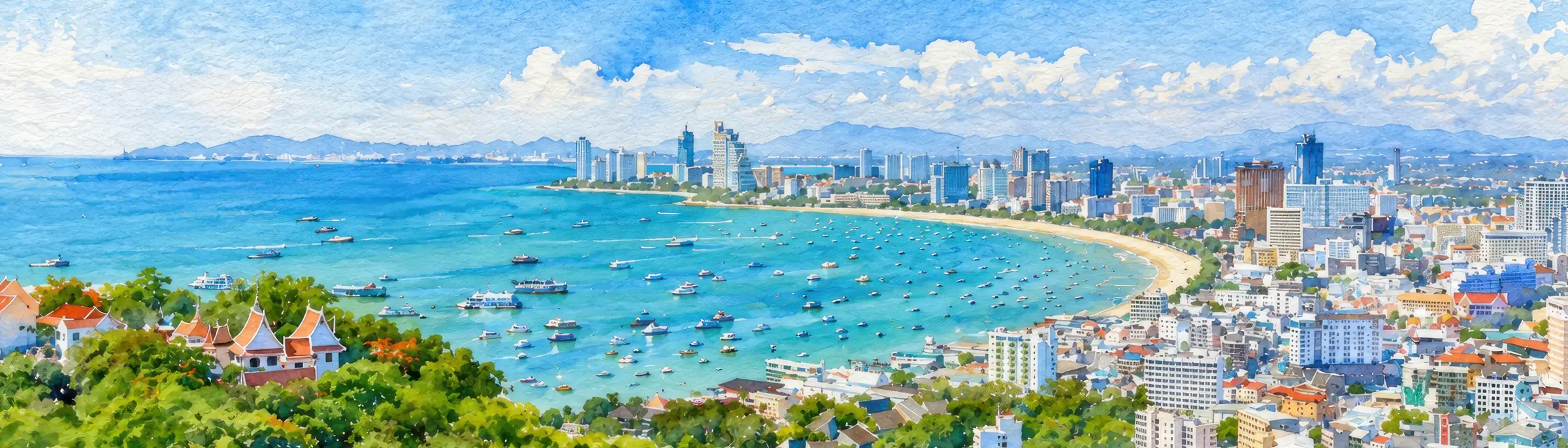
“But what if it rains?” — that is where almost every conversation about a summer shoot in Pattaya begins. Behind the question sits a ready-made picture: gray sky, a smeared horizon, the walk called off, money down the drain. The fear is almost always misplaced. For photography the rainy season here is one of the most rewarding times of year, and where it loses to clear sun is nothing like where people brace for it to.
What the weather actually does
The rainy season in Pattaya is not a wall of water from dawn to dusk. The southwest monsoon holds from roughly May into mid-November, with September and October the genuinely wet months. Even then the rain arrives in short hard bursts, most often at night — around dawn and just after sunset, when the cooling air over the warm gulf gives up its moisture. The daylight hours are almost always yours, and the morning after a night of rain hands you washed air, settled haze, and crisp, clean distances.
The slow gray drizzle people know from cooler climates simply never happens on this coast — that is the weather of the temperate continental belt, not the tropics. Two hours of unbroken downpour in Pattaya is already an event: part of the city goes underwater, and in places people really do take to boats in the streets. An ordinary burst passes in ten to fifteen minutes, after which the asphalt steams and the sky clears.
One detail a tourist doesn’t know and a photographer who lives here uses every day: the rain is very local. It pours on one edge of the city while the other stays dry. The weather service issues a single averaged forecast for the whole city — and on the screen that reads as “rain all day,” when in fact it is dripping somewhere for a quarter of an hour. So you don’t plan a shoot around “a whole day without rain”; you plan it around the breaks, and on an ordinary summer day there are more than enough of those.
An overcast sky has light enough — if you know how
Solid cloud is a studio setup waiting under the open sky. Clouds scatter the sun like one enormous diffuser: gone are the hard shadows under the cheekbones, in the eye sockets and under the chin — the very ones the midday sun ruins any face with. Skin comes out soft, small irregularities smooth themselves over, less retouching is needed, the tone is even across the frame. And, crucially in the rainy season, with cloud overhead you aren’t tied to the golden hour: you can shoot straight through noon.
Even light has a flip side: a flat whitish sky is empty in itself, and a frame without a warm accent comes out listless. A flash saves it — and not everyone can handle one. Most of the local market shoots on natural light only, and on a flat sky it shows at once: few can work a flash with any confidence. A strong photographer keeps one on almost always, yet almost never as the key light — by day it fills the shadows, in the evening it models depth, and above all it serves as a tool for separating color. With a warm conversion gel under a whitish sky, it returns to a face the sunlit “tan” the sky won’t give that day. So cloud turns from an obstacle into an even base for the light you want.
What rain can do that sun can’t
A wet city has a different palette. The main thing is that water turns surfaces into mirrors, and not just the puddles: in the evening even wet asphalt without a single puddle glows with reflected neon. The physics behind it is simple. A thin film of water smooths the surface and kills the whitish surface glare that, when dry, dilutes the color — much like a polarizing filter, only by a different route: less scattered light goes back into the eye, so the surface’s own color reads deeper. That is why asphalt, foliage, and stone grow denser in tone after rain, and a wet tile with a sign lying mirrored in it yields a frame you couldn’t gather on a dry street by any effort — especially in the evening, in neon.
Once a burst has passed, the air is washed, the haze settles, and the distances come out sharp and clean. A flash in backlight does something all its own: lit from behind, the raindrops flare in the frame like diamonds scattered through the air. Some photographers love this effect so much that they stage it without rain too — having water poured from above onto a couple standing under an umbrella; in real rain those same sparks come free, and a clear umbrella doubles as a prop that the light passes beautifully through.
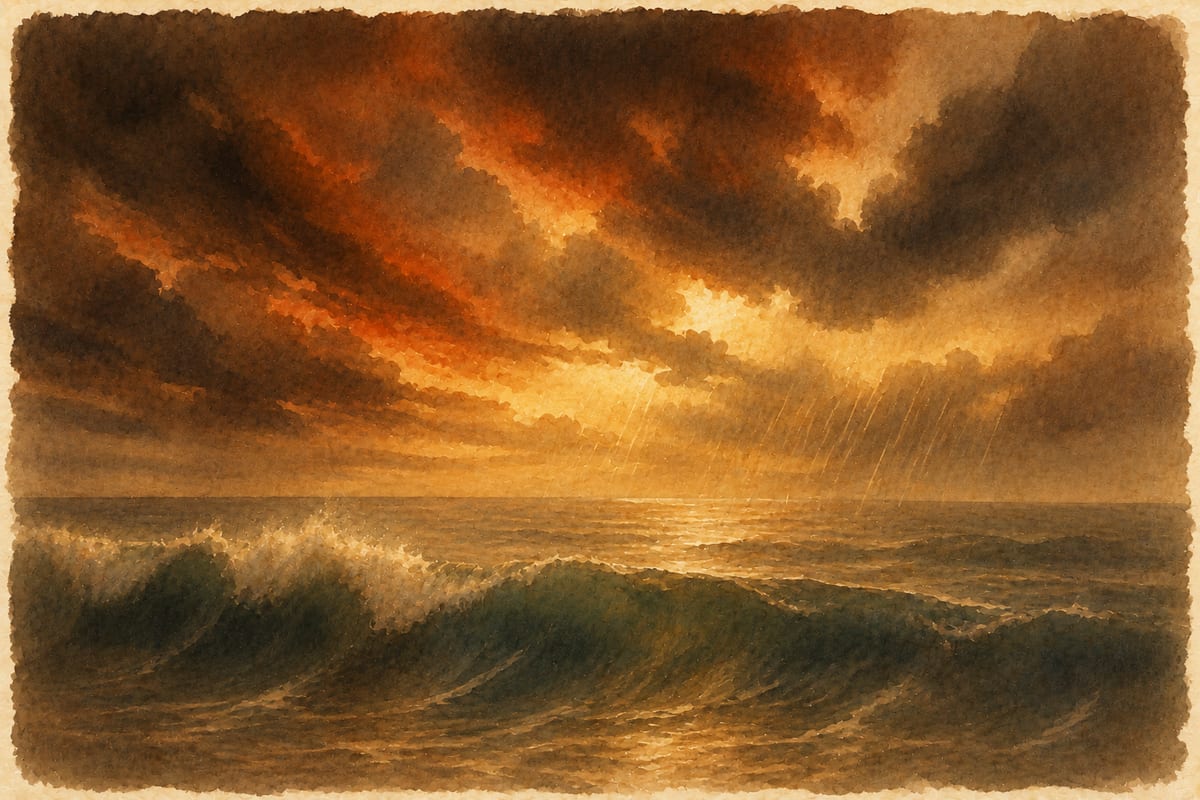
A sunset shoot in the rain is feared twice over — it seems it will not only soak you but spoil the very sky the whole thing was for. The opposite turns out to be true. Clouds at sunset in the rain give the sky relief and many tones, with breaks of light between the banks — more alive than the even orange wash of a clear evening. And along with it comes a rare bonus for these waters: waves up to a metre high. The sea off Pattaya is the sheltered Gulf of Siam, usually glassy, so there is hardly any swell here, and a big wave in a storm becomes a frame you can’t get on a calm evening.
A mood the sun can’t give
A light drizzle in the frame is a mood you can’t fake on a clear day. Rain brings a faint melancholy, a thoughtfulness, a turn inward, and the mirror-puddles express it almost literally — a reflection reads, in itself, as a look inside. In that light a person comes out quieter and truer, without the holiday gloss, closer to who they really are. The register doesn’t suit everyone: some come for sunlit joy, and that is fine. But the one who is after exactly this carries home a rare and very personal set of pictures. To borrow from Tolstoy: the happy frames all resemble one another, while a frame with mood is each one in its own way.
The purity of color in the rain is no modern discovery. The wet city, with its reflections and washed air, was a favorite subject of the Impressionists: those were precisely the atmospheric effects they hunted. In 1897 Camille Pissarro painted a whole series of the Boulevard Montmartre in different weather, and part of the run — the rainy day among them — was done from a hotel window: the very vantage point you take a client to when it starts to pour. And Gustave Caillebotte, back at the Third Impressionist Exhibition, showed Paris Street; Rainy Day: the rain there is conveyed not by drops but by reflections on the wet cobbles and open umbrellas — the same means by which the wet city is shot today.
Here the view comes more easily. The Paris painters froze for it in clammy damp — but here the rain is warm: getting wet under it is hardly chilling, and by the end of a shoot it is more an excuse to laugh than to chatter your teeth. The one caveat is not to walk into an air-conditioned room wet: straight after a shoot in the rain, don’t duck into a tourist-favorite 7‑Eleven to catch your breath — the jump from tropical humidity to a freezing hall gives you a cold more surely than the rain itself.
Technically you can shoot in any weather
What most people miss about rain is the main thing: in terms of technique, the weather barely limits the photographer. The real limit is on the client’s side, in their readiness and how they take it; you can shoot in almost any rain, and from there it all comes down to the kit.
A fair amount of rain professional-grade cameras and lenses simply shrug off — on the order of half an hour under a serious downpour with the hood on and a protective filter fitted. When it comes down harder, you shoot from under cover, at a distance: here a good sports telephoto like a 100–400 earns its keep, reaching a person from across the gap (the same trick lands posing at waterfalls and in the water park). And when you need to be all but in contact with the water — right up against a waterfall, or in it — the frame is taken from a housing, an underwater protective case for the camera.
The catch is the kit, and only that. Professional gear isn’t in every photographer’s bag, a good sports telephoto is in very few, and a camera housing in fewer still. So “you can shoot in any kind of water” isn’t true of every author — it’s one more sign by which a strong photographer is told apart from an average one.
Worse for the gear than rain is the fine salt mist by the sea — it eats away at a camera inside and out, which is why after any shoot by the water it’s worth wiping down with a damp towel. A straight tropical downpour with wind is just a pause: you wait it out under a roof for those same ten to fifteen minutes.
Where to go when it pours
A client’s calm rests half on a ready plan B, and under a roof in Pattaya there are no fewer frames than under the sky. Light from a hotel-room window is a lovely soft setup in its own right, and for a portrait you often don’t need to look any further: the very hotel light from which the Impressionists painted their rainy boulevards. A café with character — a veranda over the sea, a designer courtyard — gives you a lifestyle frame with no open sky at all. And at a temple with covered galleries the rain is no obstacle either: you move the shoot inside and carry calmly on.
What if the rain comes on the shoot day itself
This is the chief fear before booking, and it has to be answered honestly, with no promises of eternal sun. It starts with the forecast, but the forecast here is trusted with a correction: an averaged “rain all day” almost always means a local burst somewhere in the city. The storm cells are visible in advance — an experienced photographer tracks them on the weather radar the way a sailor watches for a squall. If the forecast allows for rain, photographer and client agree in advance on a check-in call an hour to ninety minutes before setting out, and decide on the facts. The client always decides: rain doesn’t stop the photographer from shooting, so at worst a portrait shoot is moved once.
The money side is just as straightforward. A small shoot often has no deposit at all, so there is nothing to lose. On a larger one, if the shoot is moved by mutual agreement, the deposit simply carries over to the new date with no loss. A wedding or a big event isn’t shifted for weather — it can’t be, logistically: those are shot under any sky, and everything covered above comes into play.
The humidity and heat also point you toward a wardrobe: light, quick-drying fabrics that don’t cling, while rich dark colors read especially deep under cloud — so it pays to think it through in advance.
Is the rainy season worth coming for, just for the photos
It is a question of a single trade. You give up the predictability of sun — and you get locations without the crowds, off-season prices, a textured sky, and a wet city that the high season simply never offers. Whoever takes that trade more often comes out ahead than behind, and is convinced of it right there on the shoot — under the warm rain they dreaded for weeks, which suddenly turns out to be the best thing that happened to the frame.