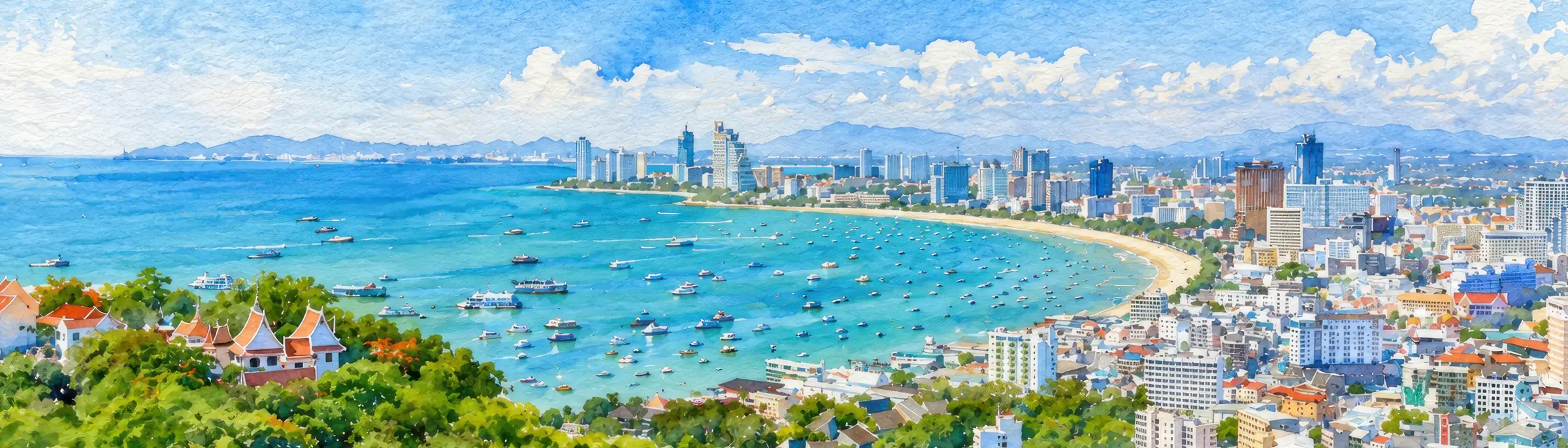
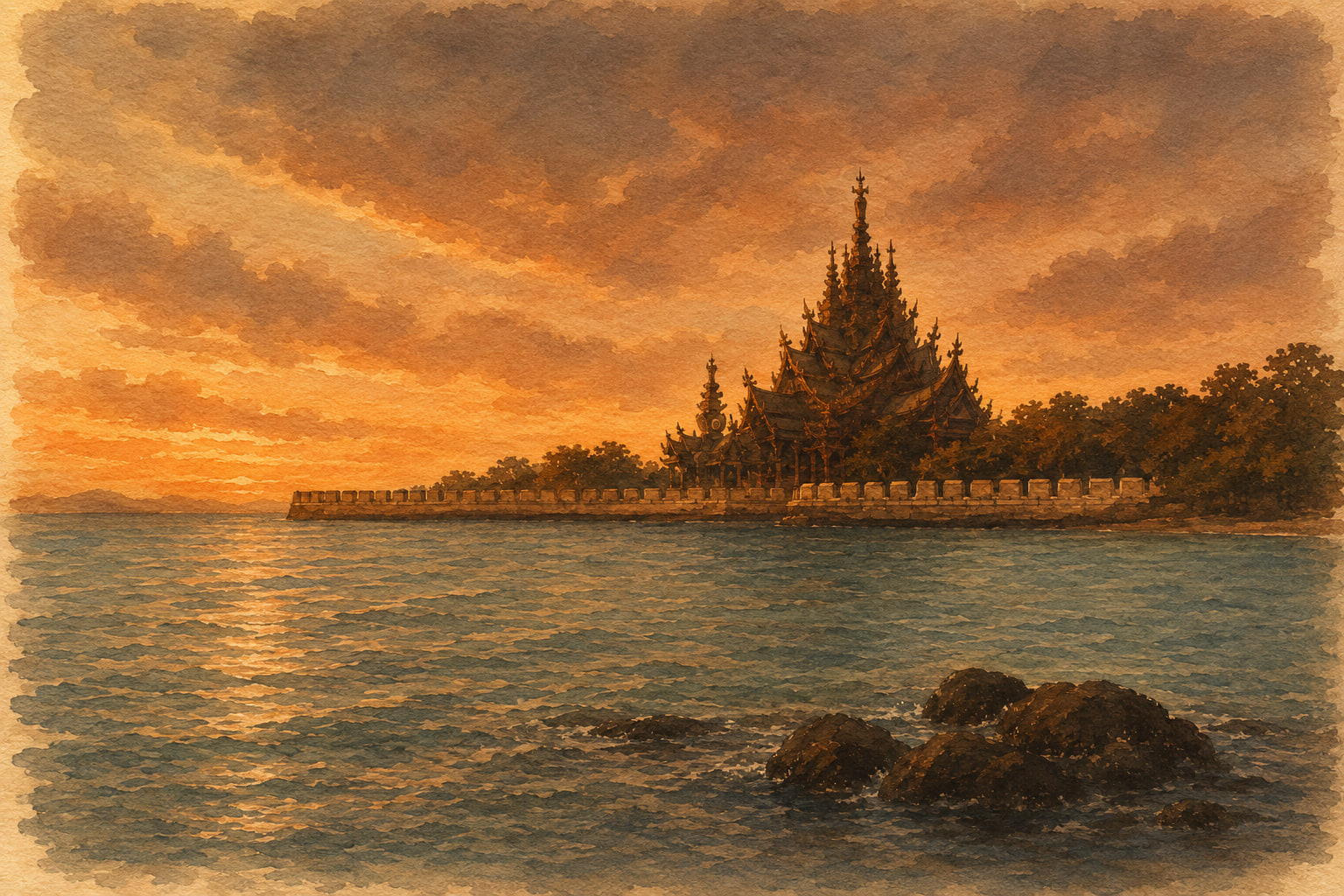
The Sanctuary of Truth is Pattaya’s most recognizable image and a favorite of travel sites and AI tools: a vast teak structure on a headland above the sea, covered in carving from top to bottom. It looks like a photographer’s dream. In practice it is one of the most awkward locations in the city, and that rarely gets said. Here is what it really is, which rules tie the photographer’s hands, and how to get that famous shot without going inside at all.
What it actually is
Calling it a temple is a stretch. It is a private monument built by the Thai millionaire Lek Viriyaphan (the man who also created Ancient Siam and the Erawan Museum). Construction began in 1981 and is still not finished. The structure is not dedicated to any particular deity and has never been consecrated as an active temple (a wat). In more than four decades Buddhist tradition has never absorbed it, and no one makes pilgrimages here: people come to look, not to pray.
For comparison, another of Viriyaphan’s projects, the Erawan Museum, has been embraced by Thais and is a living place: it has a patron, the three-headed elephant Airavata, the vahana of Indra. The Sanctuary of Truth has no patron, and you can feel it — a beautiful but rather hollow stage set.
There is a practical consequence too. The famously “rot-proof” teak weathers in the humid sea air all the same. The carving is forever being replaced, which is why the construction has gone on for decades. Part of the structure is under scaffolding, and you can go inside only in a hard hat, which few people want in their photos.
Hard hats, a guide, and a fixed route: why the angles suffer
Because the construction never stops, visitors are led around the grounds on a strictly fixed route, and each group is assigned a guide who makes sure no one strays. For a tourist that is a safety measure; for a photographer it is a cage. You cannot step back for a clean wide shot, you cannot get in close for the texture of the carving, and you cannot stand anywhere that keeps the scaffolding out of the frame. Most of the “postcard” views you have seen were shot either before the latest phase of construction or from one of the few approved spots.
Professional shoots without a permit are banned
The main thing the guidebooks don’t warn you about is that professional photography on the grounds is prohibited without separate approval. What counts as “professional” is open to argument and gets decided on the spot, but in practice it is simple: if you turn up with a photographer of your own carrying visible gear, security will almost certainly treat the shoot as professional, even if the photographer is using a phone.
The permit is arranged in advance, on a separate application (for staged and pre-wedding shoots the site is rented out by individual arrangement). Clients usually dump the whole approval hassle on the photographer, even when they are the ones paying for the permit, and that means at least one separate trip to the edge of the city beforehand. That is why photographers who have shot at the Sanctuary of Truth even once are extremely reluctant to do it again. If someone quotes you a standard location price and promises to “sort it out on the day,” they have never worked there.
Tickets, hours, and light
If you do go inside the official way, admission is around 500 baht in the daytime and about 700 for the sunset session. The site is open from 8:00 a.m. to 6:00 p.m., plus a separate evening session. The dress code is mandatory (shoulders and knees covered), and a wrap is handed out at the entrance against a refundable deposit of around 200 baht. The main facade faces west, toward the sea, so the best light is in the late afternoon and at golden hour; the crowds are thickest from 10:00 a.m. to 2:00 p.m. and thin out toward sunset. Getting there: the site is in the Naklua district, about 5 km north of the city center; a taxi costs 80–150 baht, and parking is free.
The beach behind the sanctuary: free, no permits needed
Now for what the guidebooks leave out. To get that silhouette in the shot you don’t have to go inside at all. Beyond the sanctuary grounds there is an open beach from which the whole structure can be seen, and you can shoot there for free, with no permits of any kind. An experienced photographer will place you so that the Sanctuary of Truth is the backdrop right behind you, then shoot with a long telephoto lens — no hard hats, no scaffolding, no guide, no escort. Taken from a distance, with the full silhouette, at sunset, this is often the best shot the place has to offer.
But it doesn’t just happen. A good telephoto is by no means something every portrait photographer owns. More often it is the tool of a generalist or a reportage photographer: the lens is big, heavy, and expensive, and nobody takes it to a portrait shoot unless the location is known in advance. It also needs room: about 10–15 meters to the subject and ideally 50 meters of clean background behind them. So the shot is planned in advance and the photographer is chosen to suit it; don’t count on improvising here.
What to discuss with the photographer
Have they shot here before? Someone who has will tell you straight about the permit, the hard hats, and the narrow route, and will most likely suggest the beach option themselves.
Who handles the permit? If a staged shoot inside is what you are planning, settle who clears it with the site and when. “We’ll sort it out on the day” means nobody will.
Do they own a long telephoto, and do they have a plan for shooting outside? Shooting from outside is often quicker and cheaper than working along the narrow route inside, and the picture is stronger; but not every portrait photographer has a telephoto, and a shot like this needs room and preparation ahead of time.
The Sanctuary of Truth is worth seeing, but as a photo location it almost always disappoints: a guide, hard hats, scaffolding in the frame, and a ban on shooting without a permit arranged beforehand. If it is the carved interior you want, book the official staged shoot in advance and budget time and money for it. If you want a beautiful shot with that silhouette, go out to the beach beyond the grounds and shoot with a telephoto. The second route is usually fairer on price and gives the stronger result.