A proposal is one of the few kinds of shoot with no second take. The picture happens within a single minute, and that minute doesn’t come again. The photographer can’t say, “Let’s do that once more, and this time turn a little to the right.” If it didn’t work, the moment stays in the couple’s memory but not in the photographs.
That changes everything. The standard methods of a couples shoot — talking through a pose, adjusting the light, repeating the walk — don’t work here. The photographer has to set the scene up in advance so that the decisive moment lands in the right frame with no intervention. And they have to stay unnoticed right up to that moment, so as not to give the surprise away.
How a proposal differs from a couples shoot
One shot, one chance. On an ordinary couples shoot, twenty pictures out of fifty turn out well. At a proposal the whole series may hold three to five shots around the key gesture, and one of them becomes the one that counts. If the photographer shot from a bad angle, went for the wrong moment, or simply got distracted, there is no saving the series.
Staying out of sight. On a couples shoot both people know about the camera and are ready for it. At a proposal one of them knows and the other doesn’t. The photographer has to be inside the event but outside the partner’s field of view. This isn’t the “hidden sniper behind a palm tree” of the movies. Usually the photographer is simply at the location ahead of time with a camera, looking like a tourist or like someone there to shoot another couple. The tricky part is the distance: too close gives the surprise away, too far loses the moment.
A reaction, not a pose. On a couples shoot the camera records how two people look at each other. At a proposal it records the reaction of the one who didn’t know. That’s documentary work: the job is to catch the real thing, not to compose a picture. Some photographers can do it and others can’t. A portfolio shows it at once: if all the “proposals” in a series look staged (the partner looking in exactly the right direction, the gesture perfectly clear), they were most likely shot after the fact, as a re-enactment. If there are shots with an open mouth, a hand blurred on its way to the face, an awkward first reaction, they were taken as it happened.
Context after the moment. A good proposal series isn’t a single shot of the ring. It’s a short sequence: the approach to the spot, the gesture itself, the reaction, the embrace, the first seconds after. Ten to fifteen pictures in all, no more. A photographer who comes intending to shoot fifty is working from the couples-shoot template and losing what is particular to the event.
Evening in Pattaya
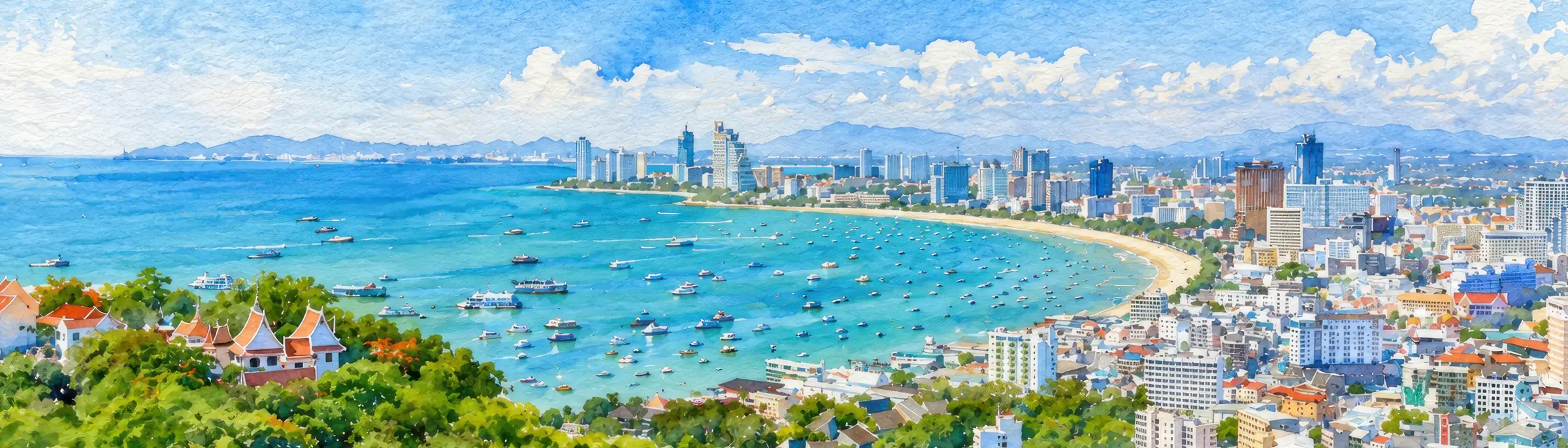
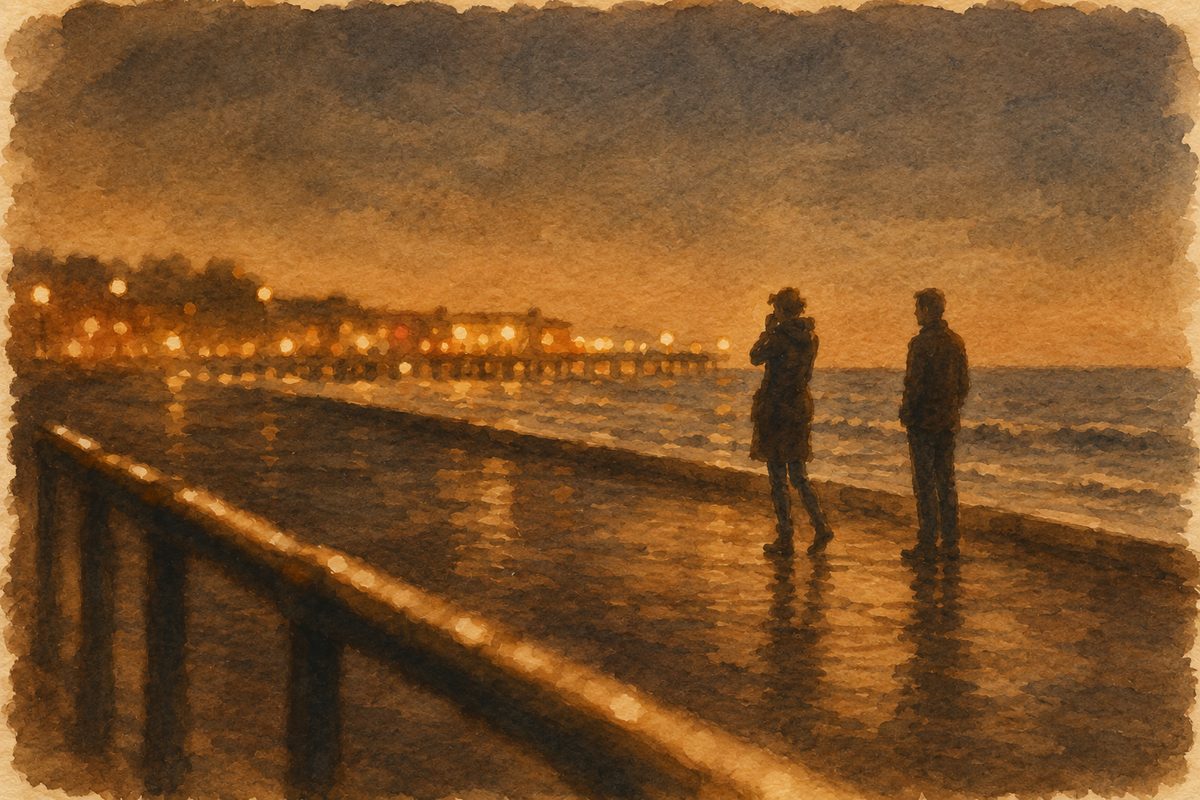
Most proposals in Pattaya are shot in the evening, between 5:00 and 7:30. That’s golden hour on the west-facing beaches (Jomtien, Wong Amat) and the time when the lights come on along the piers and promenades. The evening brings several problems that the photographer has to solve in advance.
The crowd. At 6:00 on a Saturday, Pattaya’s main “romantic” spots (the pier near the center, the Beach Road promenade, the southern end of Jomtien) are full of tourists. That’s the normal vacation crowd, but in a proposal picture it turns into visual noise. A strong photographer knows less crowded places nearby, such as a hotel garden, a quiet stretch of Naklua, or a far corner of a beach that few people know. One series in a portfolio is enough to tell: look at where the proposals were shot and whether there’s a constant crowd in the background.
The light. Sunset in Pattaya is short: about fifteen minutes from low golden light to blue twilight. That window doesn’t come twice. If the proposal is planned for 6:30, the photographer has to be in position by 6:15, with shooting spots worked out and a plan for every five minutes of the changing light. Improvising on the spot usually gives a weak series.
Location as backdrop vs. location as subject. Spectacular scenic spots (the view of Koh Larn, the silhouette of the Big Buddha on the horizon, the neon of Walking Street in the distance) make for a beautiful picture, but they sometimes take attention away from the event. A strong photographer picks a place where the background supports the scene and doesn’t become its main subject. If every “proposal” in a portfolio was shot against the same striking backdrop, that’s a template, not work done for the couple.
What to look for in a portfolio
The reaction shot. Look for the moment of surprise, hands at the face, motion blur, rather than a perfect posed portrait with both of them looking into the camera. That moment is the most valuable part of a proposal series. If a portfolio has only staged couples, then either the photographer has little experience with proposals or the series has no real moment in it, only a re-enactment.
Where it was shot from. In a strong series you can see that the photographer stood off to one side, away from the center of the scene. The picture is built on distance and a long lens rather than on posing people at close range. If every shot of a proposal was taken from a couple of meters away, the photographer was intruding on the scene.
Several locations in one series. After the moment itself there’s a short walk, some sunset shots, an embrace somewhere else. If a proposal was shot in one spot only, either the series is too short or the photographer is following a stripped-down routine.
Not just romance. In a strong portfolio, proposals are one genre among several, not a specialty. That gives you confidence that the photographer treats a couple as a couple, not as an order to “shoot a proposal from a template.”
What to discuss before the shoot
The exact place and time. “Somewhere on the beach at sunset” isn’t enough: say which pier, which end of it, and what time you’ll be there. The photographer has to be able to arrive 30 minutes early, look at the light, choose an angle, and take up position.
The signal. How will the photographer know that this is the moment? If you take the ring out without warning, they have three seconds to get ready. It’s better to agree on a signal beforehand: a movement of the hand, a turn toward the photographer, a particular phrase, a tilt of the head. That takes the worry away on both sides.
The arrival. Who gets there first? Where do you meet? If the photographer comes early and waits, they pass for a tourist who happens to be there. If they arrive with you, your partner realizes at once that something is up. Most experienced photographers work the first way.
What comes after. How many pictures are taken after the moment? How much of the series is the reaction, and how much is the newly engaged couple? Half an hour of extra shooting after the proposal is usually worth having: the couple is already full of emotion, and the pictures have life in them. If the package doesn’t include it, the series will be short.
The price. A proposal often costs a little more than an ordinary couples shoot of the same length, because of the extra coordination, the need to arrive early, and the risk that the moment falls through. If the photographer charges the same as for an ordinary couples shoot, either they underestimate what a proposal involves or you’re getting the basic version, with no serious preparation.
The language factor
Clients in Pattaya speak different languages: some English, some Thai, some only their own. A photographer who corresponds in only one language can’t coordinate a surprise with someone who doesn’t speak it. It’s an everyday barrier, and it sometimes becomes critical when a change of plan has to be settled quickly. Some of the local photographers are multilingual, but check this in advance, not on the spot.
What a portfolio can’t show
The photographer’s temperament. At a proposal the photographer is inside an emotionally charged scene: the couple is keyed up, and the photographer has to stay collected and not be a distraction. Pictures don’t tell you that. When you write to a photographer, ask how many proposals they’ve shot, and ask to hear about a difficult one. If the answer is specific (an actual situation and what they did in it), the experience is there. If it’s all generalities, either there isn’t much experience or the person doesn’t like going into detail.
A proposal is one of the most meaningful shoots in a couple’s life. It’s no place for an experiment with a photographer whose portfolio you’ve only glanced at. If you have doubts, it’s better to spend an extra hour comparing two or three candidates than to skimp and end up with a blurred shot of the key gesture.