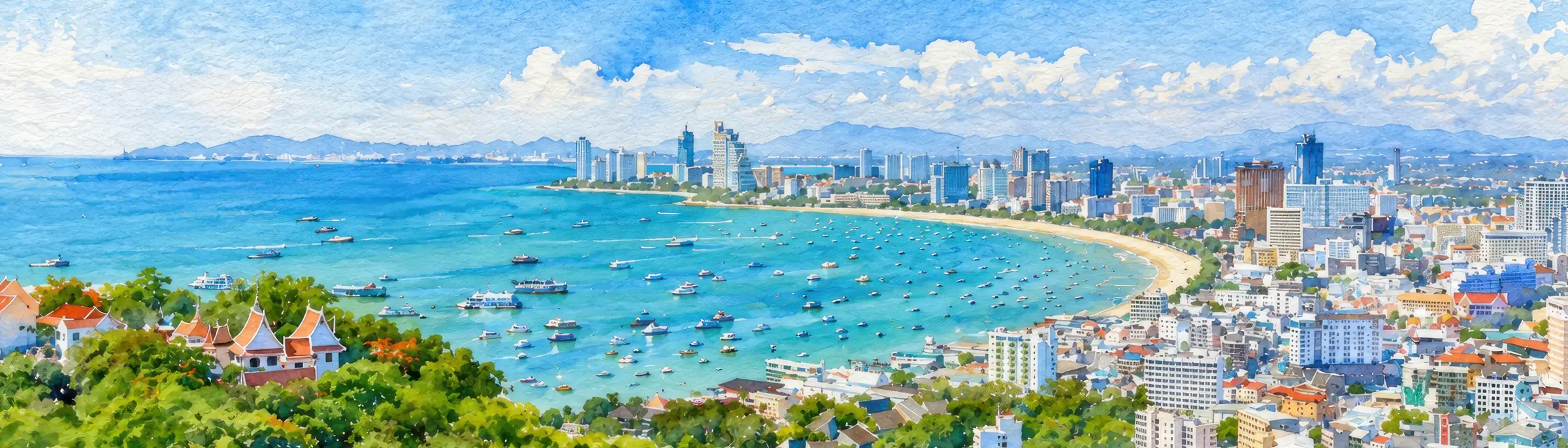
A one-hour shoot at three locations is the request vacation photographers in Pattaya hear most often. The client wants “a little by the sea, a little at the hotel, a little in the city.” On paper that’s variety. In practice it’s a compressed operation, and it rarely goes well for a photographer who has no experience working in a short format.
An hour is not three twenty-minute blocks. It’s 25–30 minutes of productive shooting, plus the time lost to moving between spots, changing light, and getting people organized. Most public portfolios show the results of an ideal one-hour shoot (a well-cast couple, experienced models, perfect light). A real family or client session, with real people in that same window, is harder.
Where the time goes in a one-hour shoot
Getting between locations. From the hotel pool to the beach is 5–10 minutes on foot. From the beach to a street location is another 10–15 minutes on foot or by motorbike. Add the time it takes to pack up and get everyone moving at each spot, and with three locations in an hour you lose 20–30 minutes just moving between them. That leaves 30–40 minutes at the locations themselves, or 10–12 minutes each, and that includes getting people organized and any delays, so the productive shooting time is shorter still. A rule of thumb: if the next spot is more than 15 minutes away on foot, you need transport, or the route needs rethinking.
Resetting between kinds of shots. Couple shots by the pool call for one kind of posing, the beach for another, the street for a third. Each change takes 2–3 minutes to get everyone repositioned and settled.
Changing light. If the shoot falls in the hour when afternoon turns to evening (4:30–5:30 p.m. in winter, half an hour to an hour later in summer), the light changes noticeably every fifteen minutes. Photos from the start of the shoot will look different from the ones at the end. That isn’t a problem if the photographer keeps it under control, but it does take adjusting.
How the clients are holding up. In an hour with three locations, most clients are tired by the end, children especially. The last location often comes out weaker than the first two: tenser faces, worse poses.
Random delays. Someone goes to the bathroom, someone lingers at a shop, someone takes a call. These eat up a disproportionate share of the hour.
When a one-hour shoot works
Scenario 1: A narrow brief focused on one location. An hour is plenty for a single location. There’s time to shoot it thoroughly, try different poses, and let the client relax. Sixty minutes on the beach in well-chosen light beats three 20-minute scrambles between locations.
Scenario 2: The grounds of a solid hotel. If every spot is inside one good 4–5-star property (pool, lobby, garden, beach access), there’s almost no walking between them, and an hour or two yields plenty of varied, good-quality photos. The sunset hour works in its own right: Pattaya’s water isn’t clear, but at sunset it takes on the color of the sky and looks beautiful — provided the photographer knows how to shoot with off-camera lighting.
Scenario 3: An experienced photographer with a strict plan. This is a photographer who knows the route in advance, the spots at each location, and the order of the shots. Before the shoot they picture the whole hour as a storyboard. That’s rare in vacation photography, but you do find it among professionals.
Scenario 4: Prepared clients. If the clients have a clear idea of what they want and which poses they’re willing to do, and they switch quickly from one setup to the next, an hour with three locations is possible.
When a one-hour shoot doesn’t work
Large families with children. Take children through three locations in an hour and the second half of the shoot is guaranteed to be a tired one. You’re better off with an hour at one location.
Clients who aren’t used to the camera. It takes 10–15 minutes for the stiffness to wear off. If the photographer is already moving on to the second location by then, the client never gets to relax.
Midday shooting. In the midday heat, an hour across three locations is a physical ordeal. It’s better to go shorter and work in controlled conditions.
Strong wind or rain. In Pattaya, the rainy season (May–October) and strong wind can make the beach part of the shoot a problem. A three-location plan often falls apart.
How to talk it through with the photographer
Ask for the plan. “We want an hour with three locations” is a request. The photographer should answer it with a plan: where you start, where you finish, how many minutes at each spot, how you get from one to the next, what happens if you fall behind. If the answer is “don’t worry, we’ll fit it all in,” they don’t have a plan, and the shoot will be chaotic.
Ask about buffer time. A good photographer will suggest 90 minutes instead of 60 if it really is a three-location job. The extra 30 minutes pay for themselves in a calmer session. If the photographer agrees to an hour without discussion, either they’re experienced at working fast or they aren’t thinking it through.
Ask about children or mobility. If the group includes a child, an older person, or someone with limited mobility, that changes the math. An hour with three locations usually doesn’t work for a group like that.
Ask about the weather. What if it rains during the shoot? If the photographer offers only the beach as the main location and there’s no backup plan, that’s a risk.
What to look for in the portfolio
A single client’s set across several locations. Instead of scattered shots from different shoots, a strong multi-location photographer shows complete sets from a single day: the same client here, then here, then here. That’s rare in a public portfolio (client privacy), but you do sometimes see it.
Different kinds of light, one look. Daytime shots with the sea in the background, shots in a hotel lobby, shots on the street in the evening — all in the same visual style. It shows that the photographer handles different conditions consistently.
Quality doesn’t drop toward the end of the set. In strong portfolios, the last shots of a set are as good as the first. In weak ones, you can see the quality fall off by the third or fourth location.
A realistic alternative
Instead of an hour with three locations, try:
-
60 minutes at one location. Thorough shooting: different angles, different poses, different people as the focus. The result is a solid set of 50–80 photos.
-
90 minutes at two locations. The spots are close together, with an easy move between them. That’s 35–40 minutes at each plus 10–15 for the move. More realistic.
-
120 minutes at three locations. A full session with no rushing between spots. It’s no longer a “one-hour shoot,” but it gets you the result you wanted.
An hour with three locations is technically possible, but the result is a compromise. Often it turns into “we tried to fit it all in and couldn’t,” and the final set comes out uneven.